Executable Scholarship
When Theory Becomes Infrastructure
The traditional lifecycle of a scholarly contribution is passive. You write a paper. It enters a journal. It waits. Maybe someone finds it, reads it, cites it. Ideas filter into the discourse slowly, often diluted, sometimes misattributed. Impact is measured in citations, a metric that lags years behind the work and rewards institutional networks as much as intellectual contribution.
But what if theory didn't have to wait to be read? What if it could run?
The conversation about AI and scholarship has been dominated by fear. Cheating. Degradation. Loss. Students using ChatGPT to write essays. Journals flooded with AI-generated slop. The slow erosion of authentic thinking.
But what if AI isn't only threatening old forms of scholarship? What if it's also revealing new ones? Forms that weren't possible before. Forms that don't replace the essay or the monograph but exist alongside them.
One such form: executable scholarship.
The Migrant Body Commodification (MBC) framework analyzes how contemporary immigration enforcement extracts political, economic, and symbolic value from migrants through engineered legal precarity. The argument identifies three models (systematic, spectacle, and transnational) and traces the mechanisms by which human beings are converted into extractable resources.
That's the paper.
But there's also something else: an AI-powered analytical instrument that encodes the framework. Users paste a news article, policy document, or executive order, and the tool applies the MBC lens. It identifies commodification models, maps value extraction streams, analyzes semantic patterns, draws comparative connections to established cases.
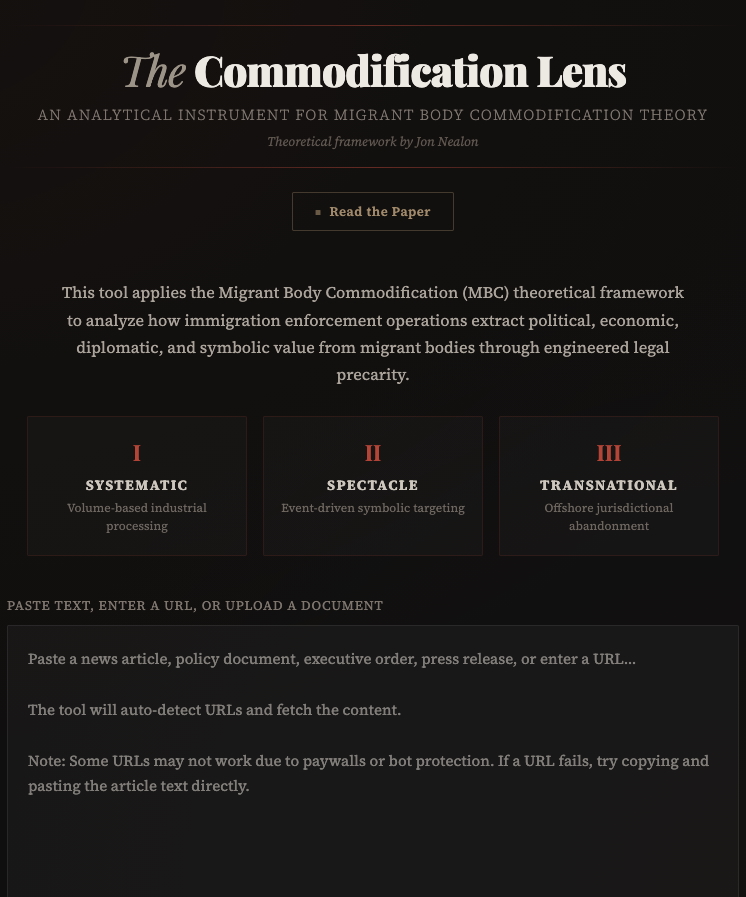
The Commodification Lens: an executable theoretical framework
The system prompt embeds the typology, the indicators, the analytical logic. Every output carries the DNA of the framework.
This isn't AI writing a paper. This is theory becoming executable.
A citation says the framework argues X.
A tool use does X.
The difference matters. A tool use means applying the framework to new material, with the analytical structure guiding the interpretation. The framework doesn't sit in a journal waiting to be activated by a reader who may or may not fully understand it. It works. It runs. It produces analysis.
A paper is inert.
It waits to be read.
An executable framework is active.
It does work in the world.
Executable scholarship won't replace traditional academic writing. Theoretical arguments still need to be made, defended, debated in prose. The peer-reviewed paper isn't going anywhere.
But executable scholarship might extend what a theoretical contribution can do. A framework that runs doesn't just inform future researchers. It works alongside them, producing framework-consistent analysis at a scale and a pace no individual scholar could achieve alone.